
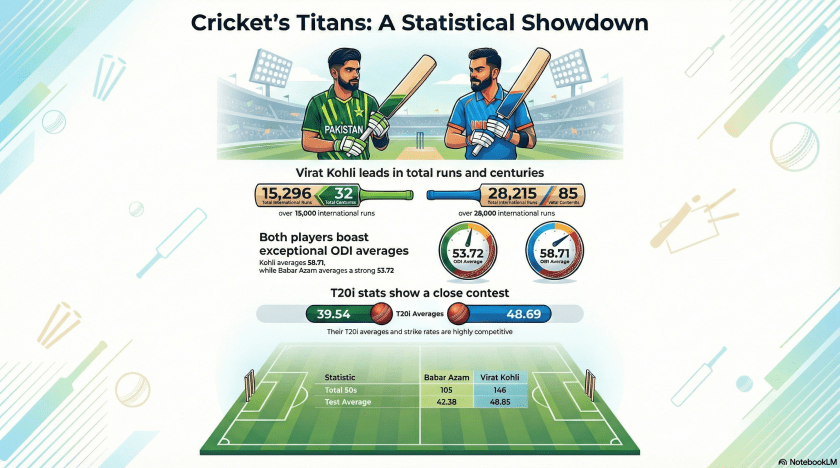
Greatness in sport is loudly celebrated, but rarely understood. The higher an athlete rises, the lonelier the space becomes. Applause grows, expectations soar, but empathy quietly disappears. Fans see centuries, trophies, endorsements, and records; they do not see the mental strain of sustaining excellence, the fear of decline, or the suffocating demand to be flawless every time they walk onto the field.
In cricket, this pressure is amplified beyond most sports. Nowhere is it more intense than in India and Pakistan, where cricket is not simply a game but a national obsession, a cultural identity, and a daily emotional investment. It is within this furnace that Virat Kohli and Babar Azam exist — and it is why their struggles tell a deeper story about the cost of being a modern sporting icon.
One of the greatest myths surrounding elite athletes is the belief in perpetual excellence. Once a player reaches the summit, the public assumes they will remain there indefinitely. Yet sport is never linear. Form fluctuates, confidence dips, bodies age, opponents adapt. Failure, however, is only forgiven for the young and expected from the average. For superstars, failure is seen as betrayal.
This is why Kohli’s 1,020-day international century drought became a global talking point, and why Babar Azam’s current lean patch dominates headlines in Pakistan. The higher the pedestal, the harsher the fall — and the louder the noise.
A slump is rarely just technical. It is psychological. A batter out of form begins to hesitate, overthink, lose instinct and play with fear rather than freedom. Every innings feels like a trial, every dismissal a confirmation of doubt. The mind clutters, the bat feels heavier, and the game feels faster than it once did. Escaping such a phase requires not just skill, but extraordinary mental resilience.
It is here that Kohli and Babar’s journeys begin to diverge. Kohli has long been known as a mental fortress. He feeds off confrontation and pressure, building his career on intensity, discipline and unshakeable self-belief. During his slump, his technique, captaincy and even his place in the T20 side were questioned. Yet he endured, absorbed the criticism, and rebuilt himself, eventually returning with centuries across formats.
Babar Azam’s struggle has followed a different emotional arc. Elegant, calm and introverted, his game relies on timing rather than aggression, humility rather than confrontation. Those very traits, however, can make him more vulnerable to relentless external noise. Comparisons with Kohli, leadership burdens, and Pakistan’s over-reliance on him as a batting saviour have visibly weighed him down. His confidence has wavered, decisions have become hesitant, and the aura that once defined his batting has dimmed.
The question now is not about talent. Babar’s class remains unquestioned and his technique world-class. The real challenge is mental recovery. A reset may require clarity of role, reduced leadership pressure, technical fine-tuning and, most importantly, time away from the noise.
There is also a growing debate over whether Babar should drop a format to prolong his career. Strategically, stepping away from T20 internationals — where criticism is loudest and Pakistan has emerging talent — could allow him to refocus on ODIs and Tests, formats better suited to his natural game. Such a move would not signal weakness, but wisdom.
History reminds us that form is temporary, but class endures. Whether Babar Azam reclaims his peak will depend not on ability, but on whether he is allowed the space to rediscover his rhythm — away from impossible expectations, and closer to the freedom that once made him special.
 American Muslims