
In modern T20 cricket, the long‑running debate between “impact batting” and “anchoring” has evolved into a structural question that shapes team selection, batting orders, and tournament strategy. Teams overloaded with accumulators often fall behind the rising scoring rates of the global game. Those built entirely on high‑volatility hitters can implode under pressure. The most successful sides of the past five years—England, Australia, India—have found a middle path: a batting unit built on relentless intent, supported by one or two stabilizers who can absorb pressure without stalling momentum.
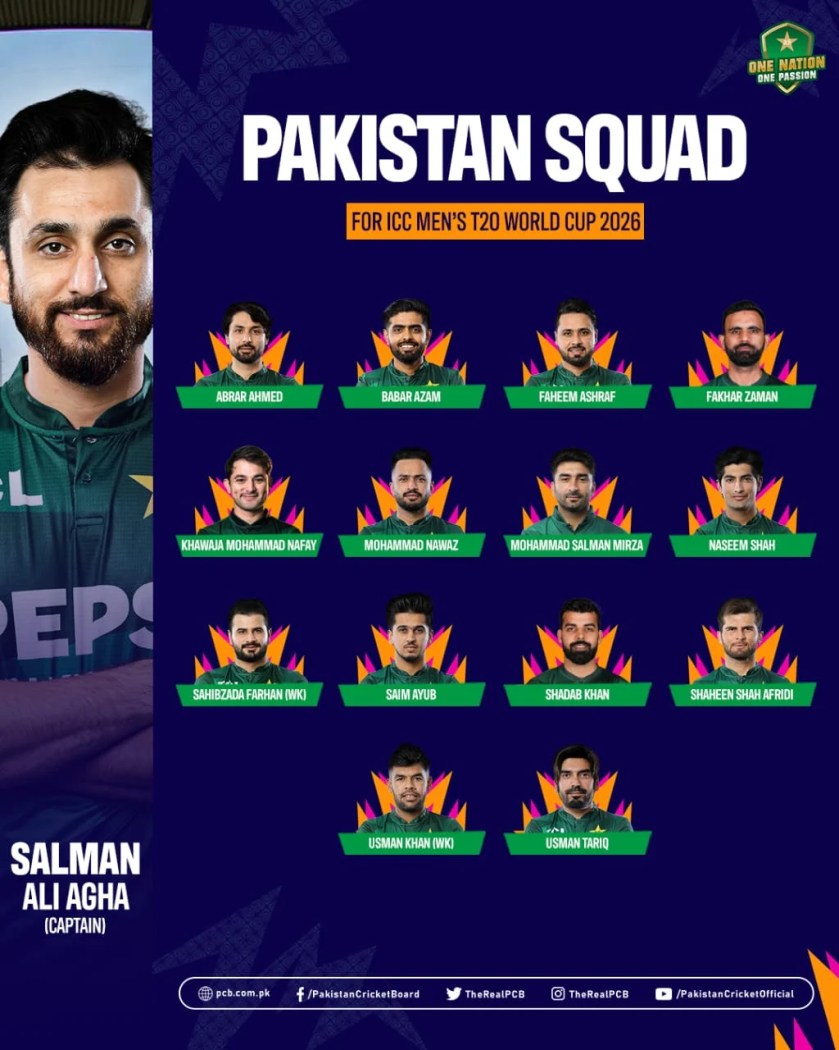
Pakistan’s newly announced squad for the 2026 T20 World Cup suggests that the selectors have finally embraced this modern template. The 15‑man roster—featuring Saim Ayub, Sahibzada Farhan, Babar Azam, Fakhar Zaman, Usman Khan, Salman Ali Agha, Khawaja Nafay, Shadab Khan, Faheem Ashraf, Mohammad Nawaz, Shaheen Afridi, Naseem Shah, Salman Mirza, Usman Tariq, and Abrar Ahmed—offers a rare blend of power, stability, all‑round depth, and wicket‑taking bowling.
For a team that has historically struggled to balance intent with consistency, this squad represents a meaningful shift.
Impact vs Anchoring: The Modern Equation
T20 cricket has become a strike‑rate‑driven format. Impact batting—defined by boundary frequency, phase‑wise acceleration, and matchup exploitation—has become the primary currency of success. Yet anchoring has not disappeared; it has simply been redefined. The modern anchor is not a 115‑strike‑rate accumulator. Instead, he is a batter who can survive early pressure, rotate strike against spin, and still finish with a strike rate in the 130–140 range.
The key is proportion. A T20 XI can carry one, at most two, anchors. Anything more becomes a liability.
Pakistan’s 2026 squad finally reflects this balance.
Why the Anchor Role Still Matters
While the global game increasingly celebrates impact hitters, the anchor remains a crucial component of a championship‑caliber T20 side. High‑intent batting brings volatility. Powerplay aggression can produce explosive starts, but it also increases the likelihood of early collapses. On slow or turning pitches—conditions Pakistan will likely encounter in Sri Lanka—stroke‑making becomes difficult, and innings often require a batter who can absorb pressure, manipulate fields, and bat deep.
Anchors also provide phase stability. When wickets fall in clusters, they prevent panic. When the pitch is two‑paced, they adjust tempo. When the opposition deploys their best spinners, they rotate strike and deny dot‑ball pressure. And when the game reaches the final overs, a set anchor can accelerate, often finishing with a strike rate that matches or exceeds the middle‑order hitters.
The anchor’s value is not measured by strike rate alone but by contextual strike rate—how they score relative to conditions, match situation, and bowling quality. This is why players like Kohli, Williamson, and Babar have remained central to their teams’ T20 plans. Pakistan’s inclusion of Babar Azam and Salman Ali Agha reflects an understanding that impact alone cannot win tournaments; stability must complement aggression.
A Top Order Built on Intent, With One Stabilizer
Pakistan’s top order features three high‑intent batters and one classical anchor.
- Saim Ayub brings fearless powerplay aggression and the ability to take down both pace and spin.
- Sahibzada Farhan, after a domestic resurgence, offers a hybrid profile—aggressive by nature but capable of batting long.
- Usman Khan is a modern T20 product with 360‑degree scoring and a strike rate consistently above 150.
- Babar Azam, the lone anchor, provides stability and the ability to bat deep into the innings.
This structure mirrors the approach used by the world’s most progressive T20 sides: three attackers supported by one stabilizer.
A Middle Order Designed for Momentum
Pakistan’s middle order has often been its weakest link. This time, it may be its competitive advantage.
- Fakhar Zaman remains one of the world’s best spin hitters and momentum shifters.
- Khawaja Nafay brings finishing power and fearlessness—traits Pakistan has lacked since the prime of Shahid Afridi.
- Shadab Khan, Mohammad Nawaz, and Faheem Ashraf offer all‑round impact, both capable of striking at 150+ in the lower middle order.
- Salman Ali Agha provides stability against spin and can anchor if early wickets fall.
This combination gives Pakistan the ability to accelerate through the middle overs—an area where they have historically lagged behind.
A Bowling Attack That Supports High‑Intent Batting
A batting strategy built on aggression only works when supported by wicket‑taking bowling. Pakistan’s attack—Shaheen Afridi, Naseem Shah, Salman Mirza, Usman Tariq, and Abrar Ahmed—offers precisely that.
Shaheen and Naseem remain one of the most dangerous new‑ball pairs in world cricket. Abrar provides mystery spin in the middle overs, while Mirza and Tariq add raw pace and bounce. With Shadab, Nawaz, and Faheem contributing as allrounders, Pakistan can field up to seven bowling options—another hallmark of modern T20 sides.
The Proposed Playing XI
Based on role clarity, matchup logic, and the impact‑vs‑anchor balance, the following XI appears most aligned with modern T20 principles:
1. Saim Ayub – Left‑hand PP aggressor
2. Sahibzada Farhan – Right‑hand hybrid attacker
3. Babar Azam – anchor role.
4. Salman Ali Agha – good against spin
5. Usman Khan – High‑intent No. 5
6. Khawaja Nafay – Finisher and power hitter
7. Mohammad Nawaz – Impact allrounder
8. Faheem Ashraf – Lower‑order hitter and seam option
9. Shaheen Afridi – Strike bowler
10. Salman Mirza or Naseem Shah – PP and death specialist
11. Abrar Ahmed – Mystery spin wicket‑taker
This XI features seven batters with strike‑rate‑first profiles, one anchor, three allrounders, and a bowling attack capable of taking wickets in every phase.
The Final Word
Pakistan’s 2026 T20 World Cup squad represents a long‑overdue shift toward modern T20 thinking. The balance between impact hitters and anchors is finally aligned with global trends. The all-rounder depth is strong. The bowling attack remains world‑class. Most importantly, the proposed XI reflects a structure built on intent rather than conservatism.
If the team management embraces the aggressive, role‑based approach this squad was built for, Pakistan could enter the tournament not as outsiders—but as genuine contenders.
 American Muslims